 Bandai
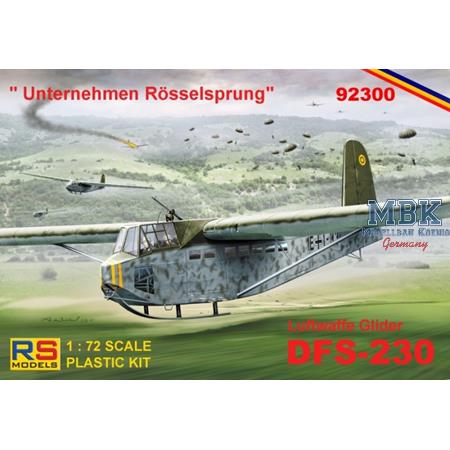


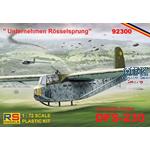
DFS-230 "Unternehmen Rösselsprung"
Item Number:
RSM92300
RSM92300
Manufacturer
RS Models
RS Models
Scale:
1:72
1:72

The DFS 230 was a German cargo glider.
It was developed in 1933 by the German Research Institute for Gliding under the direction of Hans Jacobs.
Besides the pilot, the DFS 230 offered space for nine men, who sat closely together on a narrow bench seat in the center of the fuselage.
Entry and exit from the cramped interior was via a single side door.
The front passenger could operate the only armament, a machine gun.
As an attack glider, it was designed for direct landing over the target and was therefore equipped with a braking parachute. This allowed the glider to approach the target in a dive at an angle of 80 degrees and land within 20 meters. It could carry up to 1200 kg of cargo.
The DFS 230 played an important role in the operations at Fort Eben-Emael on Crete, North Africa, as well as in the liberation of Benito Mussolini and the attack on Tito's fortress. However, it was primarily used to supply encircled troops on the Eastern Front, for example, in the Demyansk Pocket, the Kholm Pocket, at Stalingrad, and with the defenders of the fortress of Budapest.
Although production ceased in 1943, it saw service until the end of the war, for example, supplying Berlin and Breslau until May 1945.
Plastic model kit
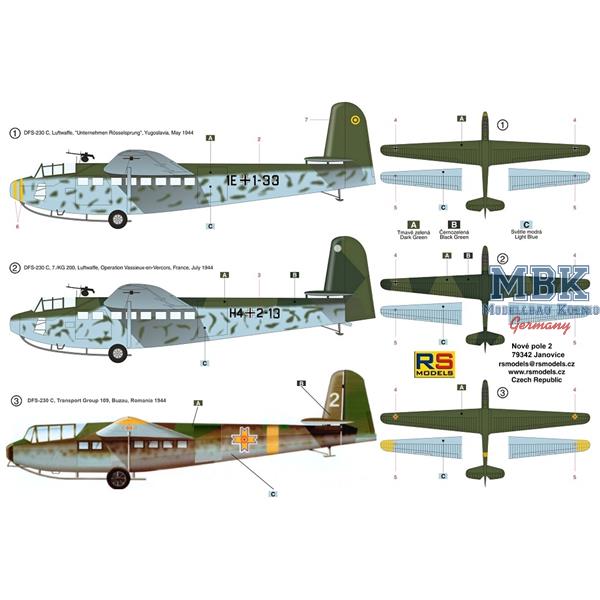
Decal options:
unbuilt / unpainted
Paint and glue not included
It was developed in 1933 by the German Research Institute for Gliding under the direction of Hans Jacobs.
Besides the pilot, the DFS 230 offered space for nine men, who sat closely together on a narrow bench seat in the center of the fuselage.
Entry and exit from the cramped interior was via a single side door.
The front passenger could operate the only armament, a machine gun.
As an attack glider, it was designed for direct landing over the target and was therefore equipped with a braking parachute. This allowed the glider to approach the target in a dive at an angle of 80 degrees and land within 20 meters. It could carry up to 1200 kg of cargo.
The DFS 230 played an important role in the operations at Fort Eben-Emael on Crete, North Africa, as well as in the liberation of Benito Mussolini and the attack on Tito's fortress. However, it was primarily used to supply encircled troops on the Eastern Front, for example, in the Demyansk Pocket, the Kholm Pocket, at Stalingrad, and with the defenders of the fortress of Budapest.
Although production ceased in 1943, it saw service until the end of the war, for example, supplying Berlin and Breslau until May 1945.
Plastic model kit
Decal options:
- DFS 230 C, Luftwaffe "Operation Rösselsprung," Yugoslavia, May 1944
- DFS 230 C, Luftwaffe, Operation Vassieux-V, France, July 1944
- DFS 230 C, Transport Group 109, Buzau, Romania, 1944
- DFS 230 C, Transport Group 109, Tri Duby Airfield, Slovakia, Spring 1945
unbuilt / unpainted
Paint and glue not included
Customer Reviews 0
Write now your personal experience with this article and help others with their purchase decision.
