Bandai


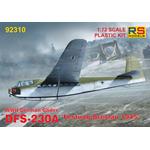
DFS-230 with Argus As 014 pulse Jets
Item Number:
RSM94030
RSM94030
Manufacturer
RS Models
RS Models
Scale:
1:72
1:72

The DFS 230 was a German military glider. It was developed in 1933 by the German Research Institute for Sailplane Flight (Deutsche Forschungsanstalt für Segelflug) under the direction of chief designer Hans Jacobs. In addition to the pilot, the glider could accommodate nine men, who sat packed closely together on a narrow bench in the center of the fuselage. Access to the cramped interior was provided by a single side door. The passenger seated at the front could operate the glider’s only armament—a machine gun. Designed for assault operations, the aircraft was intended to land directly at its target; to this end, it was equipped with a braking parachute. This allowed the glider to approach its target in an 80-degree dive and land within 20 meters of the designated touchdown point. It had a payload capacity of up to 1,200 kg.
The glider played a significant role in operations such as the assault on Fort Eben-Emael, the airborne invasion of Crete, the campaigns in North Africa, the rescue of Benito Mussolini, and the raid on Tito’s headquarters. Most notably, however, it was used on the Eastern Front to resupply encircled troops—for instance, in the Demyansk and Kholm pockets, at Stalingrad, and in the resupply of the defenders of the "Fortress of Budapest." Although production ceased in 1943, the type remained in service until the end of the war; as late as May 1945, it was still being used to deliver supplies to Berlin and Breslau.
In the summer of 1942, two Argus As 014 pulsejet engines were mounted on the wings of one of these gliders.
The aircraft was flown by test pilot Erich Klöckner. After being released from the tow aircraft, it became the first air vehicle to be powered by pulsejet engines. A fuel tank for conventional gasoline was housed in the fuselage behind the pilot, while smaller reservoirs were located in the wing roots. Since the pulsejet engine lacked its own fuel pump, fuel was delivered to the engine using compressed air; cylinders installed in the fuselage forced the gasoline through lines leading into the wings. The engine could not be started simply by opening the fuel supply; it required an initial impulse. Consequently, a separate compressed-air line ran alongside the fuel line to the front of the engine. To initiate startup, the pilot would direct compressed air into the intake chamber, which atomized the fuel. A spark plug, powered by the glider’s onboard battery, then ignited the mixture. Once the engine reached its pulsating rhythm, the auxiliary compressed-air supply and the spark plug were deactivated; the engine would then continue to run on its own, sustained by ram pressure and the heat from the preceding explosion. However, the trials were soon halted due to severe vibrations and high temperatures. Ultimately, the extreme heat and the intense vibrations transmitted to the airframe rendered the concept unsuitable for practical use, leading to the termination of the testing program.
Plastic model kit
Scale 1:72
unbuilt / unpainted
Paint and glue not included
The glider played a significant role in operations such as the assault on Fort Eben-Emael, the airborne invasion of Crete, the campaigns in North Africa, the rescue of Benito Mussolini, and the raid on Tito’s headquarters. Most notably, however, it was used on the Eastern Front to resupply encircled troops—for instance, in the Demyansk and Kholm pockets, at Stalingrad, and in the resupply of the defenders of the "Fortress of Budapest." Although production ceased in 1943, the type remained in service until the end of the war; as late as May 1945, it was still being used to deliver supplies to Berlin and Breslau.
In the summer of 1942, two Argus As 014 pulsejet engines were mounted on the wings of one of these gliders.
The aircraft was flown by test pilot Erich Klöckner. After being released from the tow aircraft, it became the first air vehicle to be powered by pulsejet engines. A fuel tank for conventional gasoline was housed in the fuselage behind the pilot, while smaller reservoirs were located in the wing roots. Since the pulsejet engine lacked its own fuel pump, fuel was delivered to the engine using compressed air; cylinders installed in the fuselage forced the gasoline through lines leading into the wings. The engine could not be started simply by opening the fuel supply; it required an initial impulse. Consequently, a separate compressed-air line ran alongside the fuel line to the front of the engine. To initiate startup, the pilot would direct compressed air into the intake chamber, which atomized the fuel. A spark plug, powered by the glider’s onboard battery, then ignited the mixture. Once the engine reached its pulsating rhythm, the auxiliary compressed-air supply and the spark plug were deactivated; the engine would then continue to run on its own, sustained by ram pressure and the heat from the preceding explosion. However, the trials were soon halted due to severe vibrations and high temperatures. Ultimately, the extreme heat and the intense vibrations transmitted to the airframe rendered the concept unsuitable for practical use, leading to the termination of the testing program.
Plastic model kit
- DFS-230, WL-VII-245, with Argus As 014 pulsejet engines, Germany, summer 1942
- DFS-230, D-14-D44, with Argus As 014 pulsejet engines, Germany 1942
Scale 1:72
unbuilt / unpainted
Paint and glue not included
Customer Reviews 0

Write now your personal experience with this article and help others with their purchase decision.