Bandai



The Heinkel He 112 was a German fighter aircraft from the first half of the 1930s that competed for a government contract for a new fighter featuring an enclosed cockpit and retractable landing gear. The contract, however, was awarded to the Bf 109. The He 112 was put into service by the Luftwaffe in the autumn of 1938 and was later sold to Hungary, Romania, and Japan. Fewer than 100 units were built.
In 1933, the Reich Aviation Ministry (RLM) issued a tender for a new fighter aircraft to replace the Heinkel He 51 and Arado Ar 68 biplanes. Designs were submitted by Arado, Focke-Wulf, Heinkel, and Messerschmitt. The Heinkel He 112 prototype was tested in October 1935 at Travemünde alongside three other aircraft types; subsequently, an order for ten units was placed. The first prototype, powered by a 518 kW Rolls-Royce Kestrel V engine, was followed by two additional aircraft with a reduced wingspan and the less powerful 447 kW Junkers Jumo 210C engine. A fourth prototype, featuring a new elliptical wing design, was field-tested in Spain by the Condor Legion in 1936 and exhibited at the Zurich aviation show in 1937. In Spain, the aircraft was flown by civilian pilots, who rated it more highly than the Bf 109C.
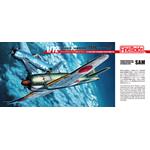
Plastic model kit
unbuilt / unpainted
Paint and glue not included
In 1933, the Reich Aviation Ministry (RLM) issued a tender for a new fighter aircraft to replace the Heinkel He 51 and Arado Ar 68 biplanes. Designs were submitted by Arado, Focke-Wulf, Heinkel, and Messerschmitt. The Heinkel He 112 prototype was tested in October 1935 at Travemünde alongside three other aircraft types; subsequently, an order for ten units was placed. The first prototype, powered by a 518 kW Rolls-Royce Kestrel V engine, was followed by two additional aircraft with a reduced wingspan and the less powerful 447 kW Junkers Jumo 210C engine. A fourth prototype, featuring a new elliptical wing design, was field-tested in Spain by the Condor Legion in 1936 and exhibited at the Zurich aviation show in 1937. In Spain, the aircraft was flown by civilian pilots, who rated it more highly than the Bf 109C.
Plastic model kit
- He 112B, delivered to Japan in 1938; Imperial University of Tokyo
- He 112B, captured and tested by the British in 1942 (alternative markings)
- He 112B, Czechoslovakia, tested by the VLU, 1939 (alternative markings)
- He 112B, Hungarian Air Force, during the Balkan Campaign (Yugoslav campaign), April 1941
unbuilt / unpainted
Paint and glue not included
Customer Reviews 0

Write now your personal experience with this article and help others with their purchase decision.