Bandai


Sd.Kfz.9 "Famo" 21cm Mörser 18 / or 17cm Kanone 18
Item Number:
REV3371
REV3371
Manufacturer
Revell
Revell
Scale:
1:72
1:72

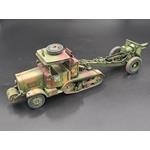
Plastic model kit for the Sd.Kfz. 9 "FAMO" with a 21cm Mörser 18 or 17cm Kanone 18
Development began in the mid-1930s. Early test vehicles were followed by the F 2 and F 3 types; the F 3 became the primary production version. Manufacturing began in the late 1930s and continued throughout the war. In addition to FAMO, Vomag and Tatra also produced the vehicles or their chassis. A total of approximately 2,500 units were built.
The FAMO was used to tow heavy artillery and transport equipment. As a recovery vehicle, it could tow medium tanks or transport them on a specialized trailer. Recovering a heavy Tiger I tank often required multiple prime movers.
The 21cm Mörser 18 was a heavy German piece of artillery from the Second World War. Although it was called a "mortar," by modern classification it was more of a heavy howitzer: its long barrel and range made it suitable for shelling distant targets. It was developed by Krupp, and series production began in 1939.
A distinctive feature was its dual-recoil carriage system: upon firing, both the barrel and the upper carriage recoiled, which reduced the stress on the carriage itself. A base plate was lowered into the ground for firing; for long-distance transport, the heavy piece was broken down into two separate loads—the barrel and the carriage.
The mortar served in independent heavy artillery battalions and was assigned to armies or corps as needed. Series production ended in 1942. The same carriage was also used for the 17 cm Kanone 18 (17 cm K 18).
The 17 cm Kanone 18 (17 cm K 18) was a German heavy long-range gun used during the Second World War. Developed by Krupp, it entered service with the Wehrmacht in 1941. Because the gun was mounted on the same carriage as the 21 cm Mörser 18 (21 cm mortar 18), its full designation was "17 cm Kanone 18 in Mörserlafette" (17 cm Gun 18 on a mortar carriage).
The K 18 was primarily intended for counter-battery fire against enemy artillery and for coastal defense. Its long range gave it a significant advantage over the 21 cm Mörser 18: it could reach targets up to 29.6 km away, whereas the mortar had a range of approximately 16.7 km. Production of the mortar was temporarily halted in 1942 in favor of the K 18. The K 18 utilized a dual-recoil carriage system: upon firing, both the barrel and the upper carriage were braked, which allowed the heavy lower carriage to remain relatively stable. For transport, the gun was typically broken down into two components: the barrel was carried on a dedicated barrel transporter, while the carriage was moved separately. For short-distance relocations, however, it could also be towed in its fully assembled configuration.
- Scale 1:72
- 361 parts
- Includes: Sd.Kfz. 9 FAMO and a choice of either the 21cm Mörser 18 or 17cm Kanone 18
- FAMO:
- Segmented tracks
- Folding windshield
- Unassembled, unpainted
- Paint and glue not included
Development began in the mid-1930s. Early test vehicles were followed by the F 2 and F 3 types; the F 3 became the primary production version. Manufacturing began in the late 1930s and continued throughout the war. In addition to FAMO, Vomag and Tatra also produced the vehicles or their chassis. A total of approximately 2,500 units were built.
The FAMO was used to tow heavy artillery and transport equipment. As a recovery vehicle, it could tow medium tanks or transport them on a specialized trailer. Recovering a heavy Tiger I tank often required multiple prime movers.
The 21cm Mörser 18 was a heavy German piece of artillery from the Second World War. Although it was called a "mortar," by modern classification it was more of a heavy howitzer: its long barrel and range made it suitable for shelling distant targets. It was developed by Krupp, and series production began in 1939.
A distinctive feature was its dual-recoil carriage system: upon firing, both the barrel and the upper carriage recoiled, which reduced the stress on the carriage itself. A base plate was lowered into the ground for firing; for long-distance transport, the heavy piece was broken down into two separate loads—the barrel and the carriage.
The mortar served in independent heavy artillery battalions and was assigned to armies or corps as needed. Series production ended in 1942. The same carriage was also used for the 17 cm Kanone 18 (17 cm K 18).
The 17 cm Kanone 18 (17 cm K 18) was a German heavy long-range gun used during the Second World War. Developed by Krupp, it entered service with the Wehrmacht in 1941. Because the gun was mounted on the same carriage as the 21 cm Mörser 18 (21 cm mortar 18), its full designation was "17 cm Kanone 18 in Mörserlafette" (17 cm Gun 18 on a mortar carriage).
The K 18 was primarily intended for counter-battery fire against enemy artillery and for coastal defense. Its long range gave it a significant advantage over the 21 cm Mörser 18: it could reach targets up to 29.6 km away, whereas the mortar had a range of approximately 16.7 km. Production of the mortar was temporarily halted in 1942 in favor of the K 18. The K 18 utilized a dual-recoil carriage system: upon firing, both the barrel and the upper carriage were braked, which allowed the heavy lower carriage to remain relatively stable. For transport, the gun was typically broken down into two components: the barrel was carried on a dedicated barrel transporter, while the carriage was moved separately. For short-distance relocations, however, it could also be towed in its fully assembled configuration.
Customer Reviews 0

Write now your personal experience with this article and help others with their purchase decision.