Bandai


USS Kidd DDG-100 (Arleigh Burke Class)
Item Number:
BN-004
BN-004
Manufacturer
BORDER MODEL
BORDER MODEL
Scale:
1:350
1:350
79.95 €
VAT included plus shipping and handling
Appears soon
We expect to arrive at middle / end of February 2027
Expected to be released middle / end of February 2027
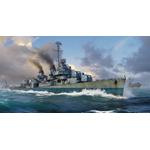
New kit from Border Model for building a US guided missile destroyer DDG-100 USS Kidd
The USS Kidd (DDG-100) is an American guided-missile destroyer of the Arleigh Burke class (Flight IIA variant) and the third ship in the U.S. Navy to be named in honor of Rear Admiral Isaac C. Kidd, who perished aboard his flagship, the USS Arizona, during the attack on Pearl Harbor.
Construction of the warship began in April 2004 at the Ingalls Shipbuilding yard in Pascagoula, Mississippi; following its launch in January 2005, the vessel was officially commissioned on June 9, 2007. During the construction phase, the hull sustained severe damage from Hurricane Katrina in August 2005, when a storm surge flooded the dry dock—necessitating extensive repairs and delaying completion by several months. Measuring approximately 155 meters in length with a displacement of over 9,200 tons, the destroyer is powered by four gas turbines, enabling it to reach speeds in excess of 30 knots. At the core of its armament and sensor suite is the state-of-the-art Aegis Combat System, which includes the powerful SPY-1D phased-array radar, as well as a 96-cell Vertical Launching System (VLS) for anti-aircraft, cruise, and anti-submarine missiles. As a Flight IIA variant, the ship also features two hangars designed to accommodate MH-60R Seahawk helicopters. Throughout her service, the USS Kidd—stationed initially in the Pacific and later on the U.S. East Coast in Norfolk, Virginia—was deployed for a wide range of global operations. These included counter-piracy efforts off the coast of Somalia, counter-narcotics missions in the Caribbean, humanitarian aid operations, and routine presence deployments in the Indo-Pacific and through the Taiwan Strait. A unique tradition aboard the ship is the hoisting of a pirate flag (the "Jolly Roger") when entering or leaving port—a custom that traces back to the first ship to bear the name during World War II.
- Pre-colored plastic parts
- Parts can be assembled without glue
- Matching colored PE and 3D printed parts (including helicopter and main gun)
- One-piece main bridge components for easy assembly
- pre-colored underwater hull and "stressed skin"
- Scale 1:350
- Unbuilt/unpainted
The USS Kidd (DDG-100) is an American guided-missile destroyer of the Arleigh Burke class (Flight IIA variant) and the third ship in the U.S. Navy to be named in honor of Rear Admiral Isaac C. Kidd, who perished aboard his flagship, the USS Arizona, during the attack on Pearl Harbor.
Construction of the warship began in April 2004 at the Ingalls Shipbuilding yard in Pascagoula, Mississippi; following its launch in January 2005, the vessel was officially commissioned on June 9, 2007. During the construction phase, the hull sustained severe damage from Hurricane Katrina in August 2005, when a storm surge flooded the dry dock—necessitating extensive repairs and delaying completion by several months. Measuring approximately 155 meters in length with a displacement of over 9,200 tons, the destroyer is powered by four gas turbines, enabling it to reach speeds in excess of 30 knots. At the core of its armament and sensor suite is the state-of-the-art Aegis Combat System, which includes the powerful SPY-1D phased-array radar, as well as a 96-cell Vertical Launching System (VLS) for anti-aircraft, cruise, and anti-submarine missiles. As a Flight IIA variant, the ship also features two hangars designed to accommodate MH-60R Seahawk helicopters. Throughout her service, the USS Kidd—stationed initially in the Pacific and later on the U.S. East Coast in Norfolk, Virginia—was deployed for a wide range of global operations. These included counter-piracy efforts off the coast of Somalia, counter-narcotics missions in the Caribbean, humanitarian aid operations, and routine presence deployments in the Indo-Pacific and through the Taiwan Strait. A unique tradition aboard the ship is the hoisting of a pirate flag (the "Jolly Roger") when entering or leaving port—a custom that traces back to the first ship to bear the name during World War II.
Customer Reviews 0

Write now your personal experience with this article and help others with their purchase decision.