


 Bandai
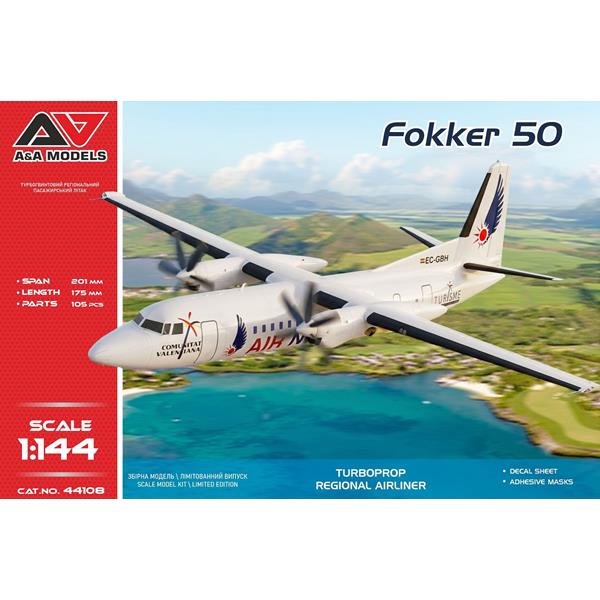
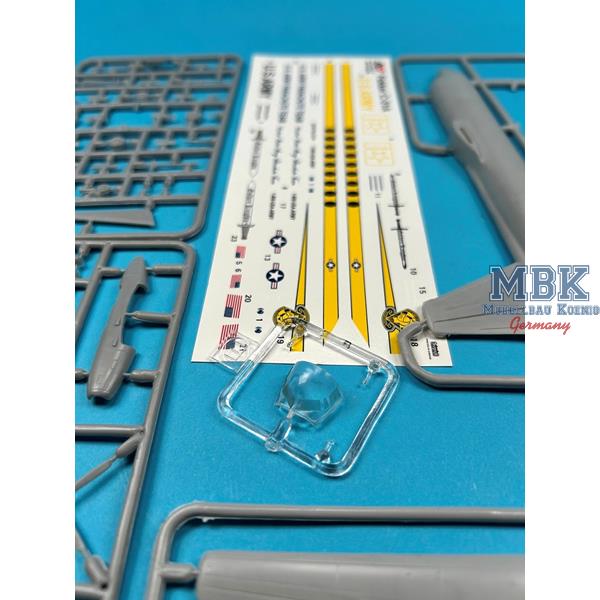
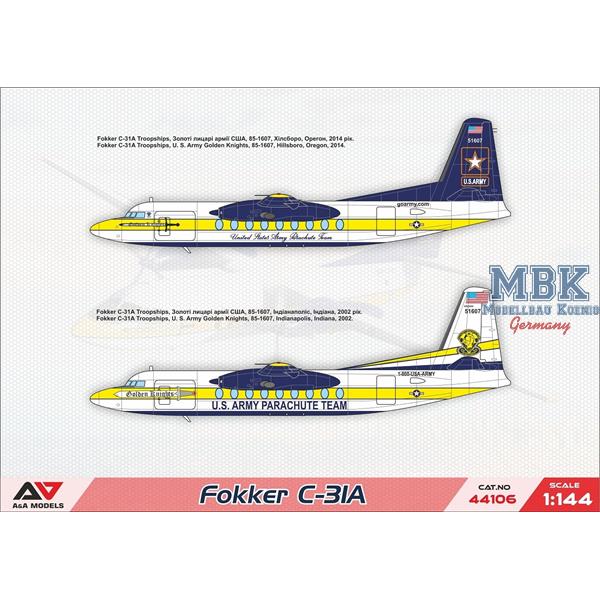


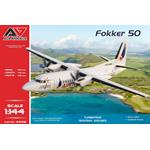
Fokker 50 Turboprop Regional Airliner
Item Number:
AAM44108
AAM44108
Manufacturer
A&A Models
A&A Models
Scale:
1:144
1:144
18.50 €
VAT included plus shipping and handling
Appears soon
We expect to arrive at early / middle of September 2026
Expected to be released early / middle of September 2026
Plastic model kit for a Fokker 50
Limited Edition
Although the Fokker 50 bears a strong external resemblance to the F27, it underwent extensive technical modernization. Key changes included Pratt & Whitney Canada PW125B or PW127B turboprop engines - delivering approximately 2,500 to 2,750 shp each - driving six-bladed Dowty-Rotol propellers. Additional features included modernized avionics, electronic engine and propeller controls, increased use of composite materials, and a redesigned wing with small winglets.
The aircraft was designed to carry typically 50 passengers; depending on the interior configuration, it could accommodate up to approximately 58 passengers. With a length of around 25.2 m, a wingspan of 29 m, and a maximum takeoff weight of approximately 20.8 tonnes, it achieved a cruising speed of roughly 520–530 km/h and a range of about 1,900–2,000 km. Its distinctive features include two turboprops mounted beneath the wings - equipped with large, six-bladed propellers - a high-mounted wing assembly, and a cabin that appears relatively slender and angular for a regional aircraft, featuring numerous small, rectangular windows. Its official certification designation is Fokker F.27-050, as the design remained based on the fundamental concept of the F27.
In addition to the civil passenger version, military and specialized variants were also produced. Notable among these was the Fokker 50 Maritime Enforcer, designed for maritime surveillance and reconnaissance. A total of 213 Fokker 50s were built - depending on the counting method used - before production ceased following Fokker's insolvency in the mid-1990s.
For scale modelers, the Fokker 50 is particularly interesting due to its distinctive combination of an F27-style fuselage, high-mounted wings, six-bladed propellers, small winglets, and modernized cockpit and avionics. It stands as one of the most well-known European turboprop regional aircraft of the 1980s and 1990s.
Limited Edition
- Scale 1:144
- Dimensions (built): Length 175 mm / Wingspan 201 mm
- 105 parts
- Painting masks included
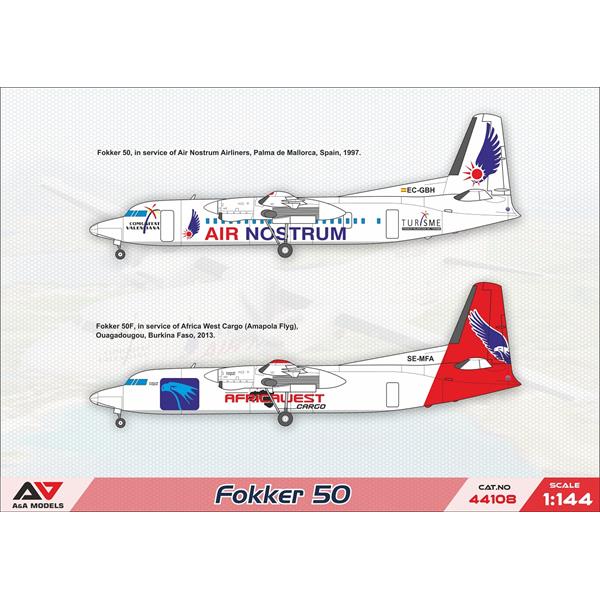
- 2 marking options
- Air Nostrum, Palma de Mallorca, Spain 1997
- Africa West Cargo (Amapola Flyg), Ouagadougou, Burkina Faso, 2013
- Unassembled, unpainted
- Paint and glue not included
Although the Fokker 50 bears a strong external resemblance to the F27, it underwent extensive technical modernization. Key changes included Pratt & Whitney Canada PW125B or PW127B turboprop engines - delivering approximately 2,500 to 2,750 shp each - driving six-bladed Dowty-Rotol propellers. Additional features included modernized avionics, electronic engine and propeller controls, increased use of composite materials, and a redesigned wing with small winglets.
The aircraft was designed to carry typically 50 passengers; depending on the interior configuration, it could accommodate up to approximately 58 passengers. With a length of around 25.2 m, a wingspan of 29 m, and a maximum takeoff weight of approximately 20.8 tonnes, it achieved a cruising speed of roughly 520–530 km/h and a range of about 1,900–2,000 km. Its distinctive features include two turboprops mounted beneath the wings - equipped with large, six-bladed propellers - a high-mounted wing assembly, and a cabin that appears relatively slender and angular for a regional aircraft, featuring numerous small, rectangular windows. Its official certification designation is Fokker F.27-050, as the design remained based on the fundamental concept of the F27.
In addition to the civil passenger version, military and specialized variants were also produced. Notable among these was the Fokker 50 Maritime Enforcer, designed for maritime surveillance and reconnaissance. A total of 213 Fokker 50s were built - depending on the counting method used - before production ceased following Fokker's insolvency in the mid-1990s.
For scale modelers, the Fokker 50 is particularly interesting due to its distinctive combination of an F27-style fuselage, high-mounted wings, six-bladed propellers, small winglets, and modernized cockpit and avionics. It stands as one of the most well-known European turboprop regional aircraft of the 1980s and 1990s.
Customer Reviews 0
Write now your personal experience with this article and help others with their purchase decision.
