Bandai


You save: 41 %
instead of: 42.50 €*
Now: 24.95 €*
VAT included plus shipping and handling
Sonderangebot
More than 5 Pieces available
Shipping 1 - 4 days
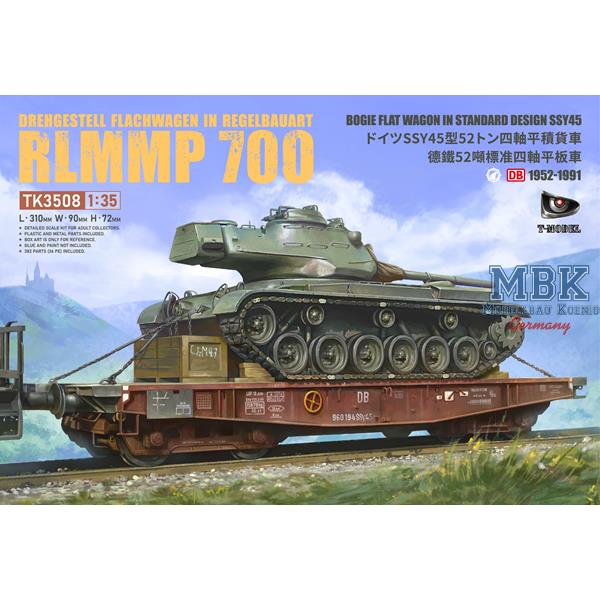
Plastic model kit to build a German four-axle bogie flatcar of the standard design RLMMP700 - Ssy45
The wagon featured a welded steel frame with a loading deck approximately 10.8 meters long and rested on two two-axle Deutz standard bogies. With a load capacity of up to 52 tonnes, it could safely transport even the heavy main battle tanks of that era. The loading deck was surfaced with wooden planks and equipped with numerous tie-down points and removable stakes, allowing for the reliable securing of tracked and wheeled vehicles, artillery pieces, bridging equipment, and other heavy cargo. Bridge plates enabled loading and unloading across multiple coupled wagons, allowing entire vehicle convoys to be quickly loaded onto trains.
Between 1941 and 1945, a total of approximately 1,930 units were produced in various versions, with the design undergoing several modifications during the manufacturing process. The standard variant introduced in 1943, characterized by straight, trapezoidal side sills, ultimately formed the basis for the SSy 45. After the war, many of these wagons remained with the Deutsche Bundesbahn and were supplemented by additional newly built units. With the introduction of the UIC designation system, they were classified as type Rlmmp 700. Many of the vehicles underwent modernization—often involving the removal of their original stakes—and were primarily used to transport heavy machinery, vehicles, and industrial equipment. Some units were later fitted with new bogies and braking systems, continuing in service as the Rlmmp 651. The last of these vehicles were not withdrawn from the fleets of the Deutsche Bundesbahn or Deutsche Bahn until the early 1990s.
Thanks to its high load capacity, ease of loading, and versatility, the SSy 45 (later Rlmmp 700) ranks among the most well-known German heavy-duty flatcars. It was an indispensable means of transport for moving heavy Wehrmacht vehicles during World War II, and its design also proved its worth in civilian freight transport for several decades thereafter.
- 1:35 scale
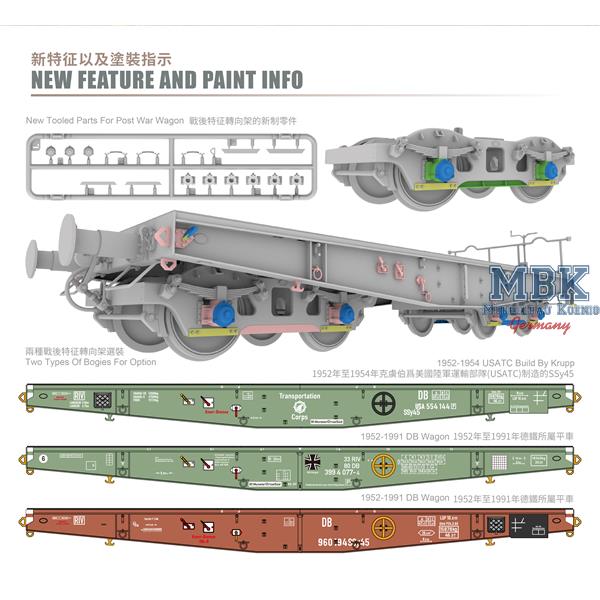
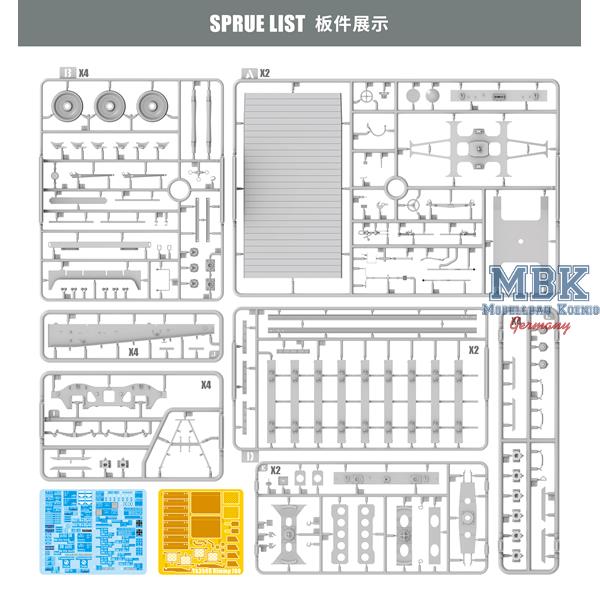
- 350+ parts
- Dimensions LxWxH (built): 310 x 90 x 72 mm
- Rails and sleepers included
- Photo-etched parts and water-slide decals included
- Markings for DB, Bundeswehr, and USATC included
- Tank is not included
- not built, not painted
- Paint and glue not included
The wagon featured a welded steel frame with a loading deck approximately 10.8 meters long and rested on two two-axle Deutz standard bogies. With a load capacity of up to 52 tonnes, it could safely transport even the heavy main battle tanks of that era. The loading deck was surfaced with wooden planks and equipped with numerous tie-down points and removable stakes, allowing for the reliable securing of tracked and wheeled vehicles, artillery pieces, bridging equipment, and other heavy cargo. Bridge plates enabled loading and unloading across multiple coupled wagons, allowing entire vehicle convoys to be quickly loaded onto trains.
Between 1941 and 1945, a total of approximately 1,930 units were produced in various versions, with the design undergoing several modifications during the manufacturing process. The standard variant introduced in 1943, characterized by straight, trapezoidal side sills, ultimately formed the basis for the SSy 45. After the war, many of these wagons remained with the Deutsche Bundesbahn and were supplemented by additional newly built units. With the introduction of the UIC designation system, they were classified as type Rlmmp 700. Many of the vehicles underwent modernization—often involving the removal of their original stakes—and were primarily used to transport heavy machinery, vehicles, and industrial equipment. Some units were later fitted with new bogies and braking systems, continuing in service as the Rlmmp 651. The last of these vehicles were not withdrawn from the fleets of the Deutsche Bundesbahn or Deutsche Bahn until the early 1990s.
Thanks to its high load capacity, ease of loading, and versatility, the SSy 45 (later Rlmmp 700) ranks among the most well-known German heavy-duty flatcars. It was an indispensable means of transport for moving heavy Wehrmacht vehicles during World War II, and its design also proved its worth in civilian freight transport for several decades thereafter.
Suitable Accessories



Customer Reviews 6
Write now your personal experience with this article and help others with their purchase decision.