Bandai
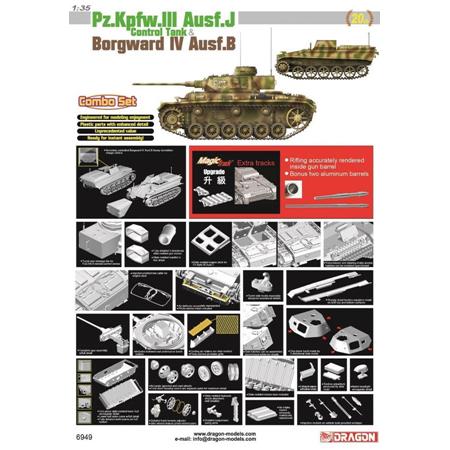


Panzer III Ausf. J Control Tank + Borgward IV B
Item Number:
6949
6949
Manufacturer
DRAGON
DRAGON
Scale:
1:35
1:35

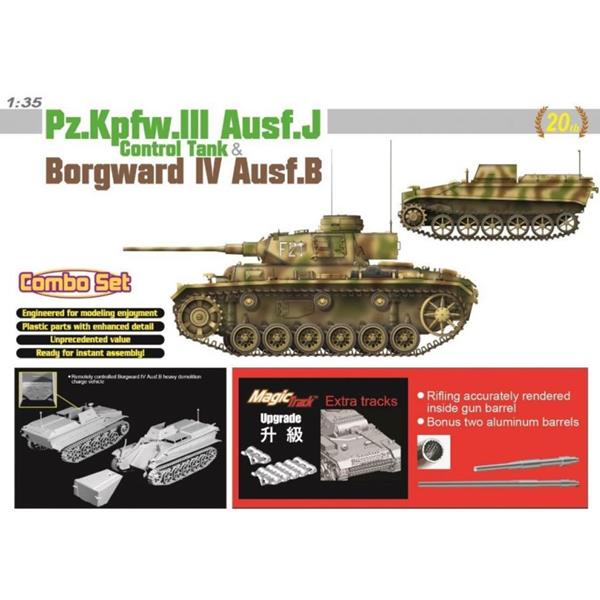
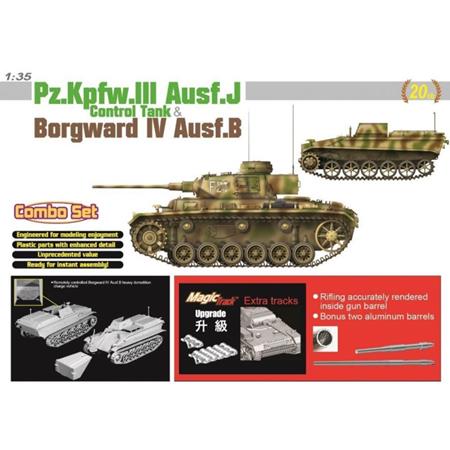
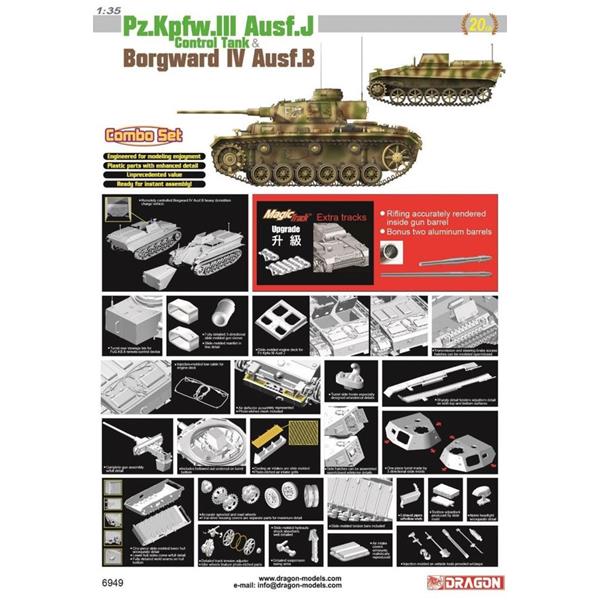
Plastic model kit for a Panzer III Ausf. J Control Tank and a Borgward IV Ausf. B demolition tank
COMBO set – 2 complete kits
The Funklenkpanzer III Ausf. J (radio-control command tank) was a specially modified German tank from World War II, used as a command vehicle for the Borgward B IV remote-controlled demolition vehicle. The objective of this weapon system was to engage heavily fortified positions, bunkers, minefields, or other particularly dangerous targets from a safe distance, without directly endangering the crew. The command tank controlled the unmanned demolition vehicle via radio, conducting the operation from a protected position.
The vehicle was based on the Panzer III Ausf. J; its proven chassis, reliable running gear, and good mobility made it ideally suited for this role. It was powered by a 300 hp Maybach HL 120 TRM twelve-cylinder gasoline engine, giving the approximately 22-ton tank a top speed of around 40 km/h. The crew consisted of five men. Unlike the standard Panzer III, the armament - comprising the 5 cm KwK 39 L/60 gun and two 7.92 mm MG 34 machine guns - remained fully intact, allowing the command tank to defend itself.
The most significant modification was internal: radio control units, additional radio equipment, and controls for steering the Borgward B IV were installed. The crew could steer the demolition vehicle via radio to the target, where it would drop its approximately 450-kilogram explosive charge and then withdraw or - if necessary - be destroyed along with the charge. During this process, the command tank had to maintain visual contact with the Borgward, as direct observation was essential for precise control. Radio-controlled Panzer III tanks were organized into specialized Panzer-Abteilungen (Fkl) (radio-controlled tank battalions) and deployed on various fronts starting in 1942, including the Eastern Front, Italy, and the fighting in Normandy. They saw particularly extensive use during the Battle of Kursk, where they were employed to overcome Soviet minefields and field fortifications. In practice, however, the radio-controlled vehicles proved prone to malfunctions. Radio interference, difficult terrain, enemy fire, and the limited range of the control system frequently resulted in the Borgward vehicles failing to reach their targets or breaking down prematurely.
Despite these limitations, the radio-control Panzer III Ausf. J represented an early attempt to integrate unmanned ground vehicles into combat operations. The combination of an armed command vehicle and a remote-controlled demolition carrier was ahead of its time and is now regarded as a significant step in the development of remote-controlled military systems. Although the concept did not achieve widespread operational success due to its technical limitations, it offers remarkable insight into the innovative - albeit often experimental - weapon technologies of World War II.
Borgward IV Ausf. B demolition tank
The Borgward B IV Ausf. B (Sd.Kfz. 301) was the most widely produced variant of the German remote-controlled demolition tank used during World War II. Developed by Borgward-Werke AG, the vehicle was designed to engage heavily fortified positions, bunkers, tank obstacles, and minefields without directly endangering the crew of a combat tank. Unlike the smaller Goliath demolition tank, the Borgward B IV transported its explosive charge right up to the target, deposited it there, and could then return to its starting point to be redeployed.
The Ausf. B variant was developed from the initial production version and addressed numerous weaknesses of its predecessor. The vehicle featured reinforced frontal armor (up to 20 mm thick) and technical improvements to the suspension, steering, and radio system, significantly enhancing its reliability and operational value. Weighing approximately 3.6 tons, the demolition tank was powered by a Borgward six-cylinder gasoline engine producing around 78 hp, allowing for a top speed of up to 38 km/h. It was operated by a driver who steered the vehicle during normal transit up to the vicinity of the operational area. Only then would a radio-controlled Panzer III—or later, a radio-controlled Tiger—take over remote control.
The primary mission of the Borgward B IV was to transport an explosive charge weighing approximately 450 kilograms, which was deposited hydraulically or mechanically in front of the vehicle. The demolition vehicle could then withdraw before the charge was electrically detonated. This procedure clearly distinguished the Borgward from other remote-controlled demolition vehicles, whose entire structures were destroyed along with their explosive charges. Nevertheless, the vehicles often proved vulnerable in combat to artillery, anti-tank weapons, and even heavy infantry fire, as their armor offered protection only against small arms and shrapnel.
The Borgward B IV Ausf. B was deployed with remote-controlled tank units (*Panzer-Abteilungen (Fkl)*) starting in 1943, seeing action on the Eastern Front, in Italy, and during the fighting in Normandy, among other theaters. During the Battle of Kursk in particular, the vehicles were tasked with clearing minefields and destroying Soviet fortifications. In practice, however, radio interference, difficult terrain, limited visibility, and enemy fire frequently led to operational failures, meaning the results achieved fell short of expectations.
In total, several hundred vehicles of the Ausf. B variant were produced, making it the primary version manufactured. Despite its limited military effectiveness, the Borgward B IV Ausf. B ranks among the most technically interesting specialized vehicles of the Wehrmacht. As a reusable remote-controlled demolition vehicle, it represented an early precursor to modern unmanned ground vehicles and illustrates the attempt to carry out hazardous combat engineering tasks using remote-controlled technology.
COMBO set – 2 complete kits
- 1:35 scale
- Includes Magic Tracks for the control tank
- Two turned aluminum barrels
- Photo-etched parts included
- Unassembled and unpainted
- Paint and glue not included
The Funklenkpanzer III Ausf. J (radio-control command tank) was a specially modified German tank from World War II, used as a command vehicle for the Borgward B IV remote-controlled demolition vehicle. The objective of this weapon system was to engage heavily fortified positions, bunkers, minefields, or other particularly dangerous targets from a safe distance, without directly endangering the crew. The command tank controlled the unmanned demolition vehicle via radio, conducting the operation from a protected position.
The vehicle was based on the Panzer III Ausf. J; its proven chassis, reliable running gear, and good mobility made it ideally suited for this role. It was powered by a 300 hp Maybach HL 120 TRM twelve-cylinder gasoline engine, giving the approximately 22-ton tank a top speed of around 40 km/h. The crew consisted of five men. Unlike the standard Panzer III, the armament - comprising the 5 cm KwK 39 L/60 gun and two 7.92 mm MG 34 machine guns - remained fully intact, allowing the command tank to defend itself.
The most significant modification was internal: radio control units, additional radio equipment, and controls for steering the Borgward B IV were installed. The crew could steer the demolition vehicle via radio to the target, where it would drop its approximately 450-kilogram explosive charge and then withdraw or - if necessary - be destroyed along with the charge. During this process, the command tank had to maintain visual contact with the Borgward, as direct observation was essential for precise control. Radio-controlled Panzer III tanks were organized into specialized Panzer-Abteilungen (Fkl) (radio-controlled tank battalions) and deployed on various fronts starting in 1942, including the Eastern Front, Italy, and the fighting in Normandy. They saw particularly extensive use during the Battle of Kursk, where they were employed to overcome Soviet minefields and field fortifications. In practice, however, the radio-controlled vehicles proved prone to malfunctions. Radio interference, difficult terrain, enemy fire, and the limited range of the control system frequently resulted in the Borgward vehicles failing to reach their targets or breaking down prematurely.
Despite these limitations, the radio-control Panzer III Ausf. J represented an early attempt to integrate unmanned ground vehicles into combat operations. The combination of an armed command vehicle and a remote-controlled demolition carrier was ahead of its time and is now regarded as a significant step in the development of remote-controlled military systems. Although the concept did not achieve widespread operational success due to its technical limitations, it offers remarkable insight into the innovative - albeit often experimental - weapon technologies of World War II.
Borgward IV Ausf. B demolition tank
The Borgward B IV Ausf. B (Sd.Kfz. 301) was the most widely produced variant of the German remote-controlled demolition tank used during World War II. Developed by Borgward-Werke AG, the vehicle was designed to engage heavily fortified positions, bunkers, tank obstacles, and minefields without directly endangering the crew of a combat tank. Unlike the smaller Goliath demolition tank, the Borgward B IV transported its explosive charge right up to the target, deposited it there, and could then return to its starting point to be redeployed.
The Ausf. B variant was developed from the initial production version and addressed numerous weaknesses of its predecessor. The vehicle featured reinforced frontal armor (up to 20 mm thick) and technical improvements to the suspension, steering, and radio system, significantly enhancing its reliability and operational value. Weighing approximately 3.6 tons, the demolition tank was powered by a Borgward six-cylinder gasoline engine producing around 78 hp, allowing for a top speed of up to 38 km/h. It was operated by a driver who steered the vehicle during normal transit up to the vicinity of the operational area. Only then would a radio-controlled Panzer III—or later, a radio-controlled Tiger—take over remote control.
The primary mission of the Borgward B IV was to transport an explosive charge weighing approximately 450 kilograms, which was deposited hydraulically or mechanically in front of the vehicle. The demolition vehicle could then withdraw before the charge was electrically detonated. This procedure clearly distinguished the Borgward from other remote-controlled demolition vehicles, whose entire structures were destroyed along with their explosive charges. Nevertheless, the vehicles often proved vulnerable in combat to artillery, anti-tank weapons, and even heavy infantry fire, as their armor offered protection only against small arms and shrapnel.
The Borgward B IV Ausf. B was deployed with remote-controlled tank units (*Panzer-Abteilungen (Fkl)*) starting in 1943, seeing action on the Eastern Front, in Italy, and during the fighting in Normandy, among other theaters. During the Battle of Kursk in particular, the vehicles were tasked with clearing minefields and destroying Soviet fortifications. In practice, however, radio interference, difficult terrain, limited visibility, and enemy fire frequently led to operational failures, meaning the results achieved fell short of expectations.
In total, several hundred vehicles of the Ausf. B variant were produced, making it the primary version manufactured. Despite its limited military effectiveness, the Borgward B IV Ausf. B ranks among the most technically interesting specialized vehicles of the Wehrmacht. As a reusable remote-controlled demolition vehicle, it represented an early precursor to modern unmanned ground vehicles and illustrates the attempt to carry out hazardous combat engineering tasks using remote-controlled technology.
Customer Reviews 0
Write now your personal experience with this article and help others with their purchase decision.
Customers also bought