Bandai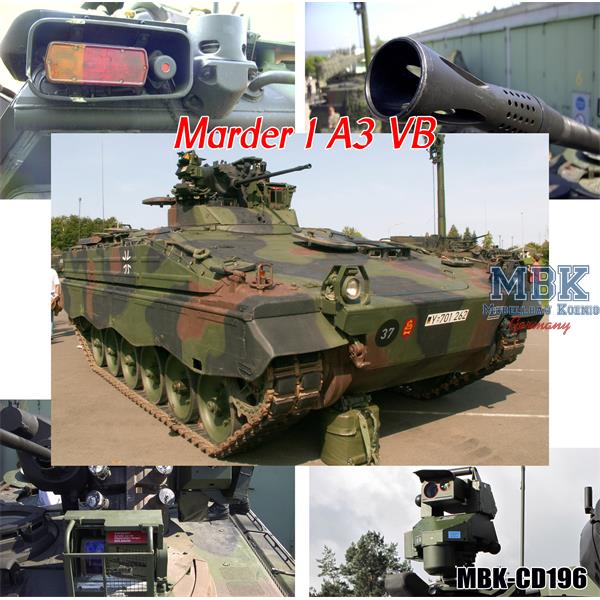


Referenz-Foto CD "Marder 1 A3 VB"
Item Number:
MBK-FCD196
MBK-FCD196
Manufacturer
Modellbau-König
Modellbau-König
Photo CD with reference photos for the military / vehicle enthusiasts and modellers.
Overall views and details from all areas of vehicle.
37 photos in JPG format (playable in any standard PC with CD drive and many current DVD players)
The Marder 1A3 infantry fighting vehicle, configured as a Forward Observer (FO) vehicle, represents a specialized variant of the well-known Marder platform, utilized by Bundeswehr artillery units for fire control and target reconnaissance. Although the Marder was originally developed as an armored combat vehicle for mechanized infantry, its robust design, high mobility, and excellent off-road capability also made it an ideal platform for battlefield observation and command tasks.
Development of the Marder began in the 1960s, driven by the Bundeswehr's need for a modern infantry fighting vehicle for its mechanized forces. Following its introduction in the early 1970s, the vehicle underwent continuous development. The Marder 1A3 variant emerged in the late 1980s as the result of a comprehensive combat capability upgrade. Key features included significantly improved armor protection against modern threats, alongside numerous detailed enhancements to the vehicle's structure and interior.
For its role as a Forward Observer vehicle, the Marder was equipped with additional communication and command systems, enabling the crew to coordinate artillery fire and identify targets for fire support. The Forward Observer's mission involved operating as far forward as possible within the combat zone—in close cooperation with frontline troops—to monitor enemy forces, determine target coordinates, and assess the impact of artillery fire. The Marder’s protected platform allowed for operations in areas where unarmored observation vehicles would have been too vulnerable.
The Marder 1A3 is powered by a 600 hp MTU six-cylinder diesel engine. Despite a combat weight of approximately 33 tonnes, the vehicle is capable of reaching speeds of up to 65 km/h. The running gear, featuring six road wheels per side and torsion-bar suspension, ensures excellent off-road mobility, enabling the vehicle to keep pace with combat troops even in challenging terrain.
Externally, the VB variant often differs from standard infantry fighting vehicles only in minor details. Characteristic features of this version include additional antenna arrays, specialized radio equipment, and systems for observation and fire control tasks. The original 20mm Rh 202 autocannon was generally retained, ensuring the vehicle maintained an effective self-defense capability.
For many years, the Marder 1A3 VB played a vital role in the Bundeswehr’s artillery reconnaissance and fire control operations. Its role was only gradually superseded by the introduction of modern command and observation vehicles based on other platforms. Nevertheless, this variant serves as an interesting example of the versatility of the Marder system, which was utilized far beyond its original function as an infantry fighting vehicle.
Overall views and details from all areas of vehicle.
37 photos in JPG format (playable in any standard PC with CD drive and many current DVD players)
The Marder 1A3 infantry fighting vehicle, configured as a Forward Observer (FO) vehicle, represents a specialized variant of the well-known Marder platform, utilized by Bundeswehr artillery units for fire control and target reconnaissance. Although the Marder was originally developed as an armored combat vehicle for mechanized infantry, its robust design, high mobility, and excellent off-road capability also made it an ideal platform for battlefield observation and command tasks.
Development of the Marder began in the 1960s, driven by the Bundeswehr's need for a modern infantry fighting vehicle for its mechanized forces. Following its introduction in the early 1970s, the vehicle underwent continuous development. The Marder 1A3 variant emerged in the late 1980s as the result of a comprehensive combat capability upgrade. Key features included significantly improved armor protection against modern threats, alongside numerous detailed enhancements to the vehicle's structure and interior.
For its role as a Forward Observer vehicle, the Marder was equipped with additional communication and command systems, enabling the crew to coordinate artillery fire and identify targets for fire support. The Forward Observer's mission involved operating as far forward as possible within the combat zone—in close cooperation with frontline troops—to monitor enemy forces, determine target coordinates, and assess the impact of artillery fire. The Marder’s protected platform allowed for operations in areas where unarmored observation vehicles would have been too vulnerable.
The Marder 1A3 is powered by a 600 hp MTU six-cylinder diesel engine. Despite a combat weight of approximately 33 tonnes, the vehicle is capable of reaching speeds of up to 65 km/h. The running gear, featuring six road wheels per side and torsion-bar suspension, ensures excellent off-road mobility, enabling the vehicle to keep pace with combat troops even in challenging terrain.
Externally, the VB variant often differs from standard infantry fighting vehicles only in minor details. Characteristic features of this version include additional antenna arrays, specialized radio equipment, and systems for observation and fire control tasks. The original 20mm Rh 202 autocannon was generally retained, ensuring the vehicle maintained an effective self-defense capability.
For many years, the Marder 1A3 VB played a vital role in the Bundeswehr’s artillery reconnaissance and fire control operations. Its role was only gradually superseded by the introduction of modern command and observation vehicles based on other platforms. Nevertheless, this variant serves as an interesting example of the versatility of the Marder system, which was utilized far beyond its original function as an infantry fighting vehicle.
Customer Reviews 0

Write now your personal experience with this article and help others with their purchase decision.