 Bandai
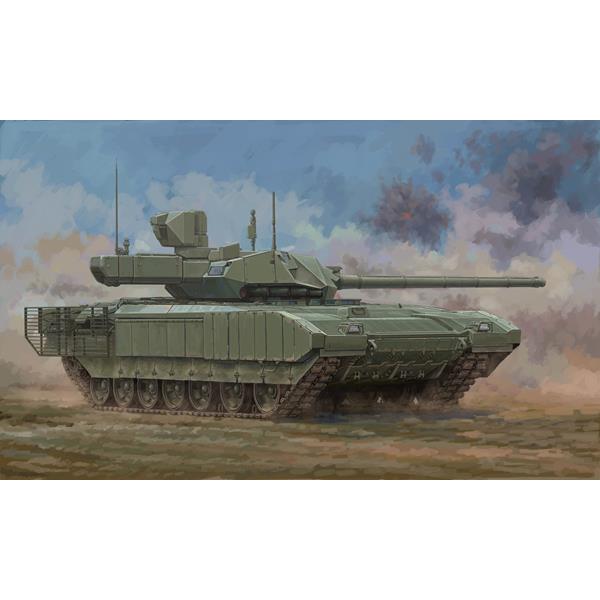
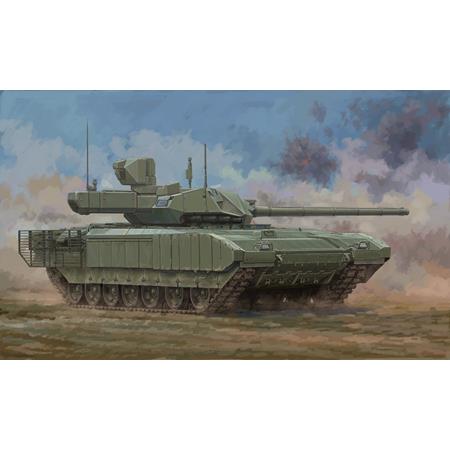

Russian T-14 Armata MBT Mod.2022
Item Number:
TRU09615
TRU09615
Manufacturer
TRUMPETER
TRUMPETER
Scale:
1:35
1:35

37.60 €
VAT included plus shipping and handling
Appears soon
We expect to arrive at middle / end of November 2026
Expected to be released middle / end of November 2026
Complete assembly kit for a Russian T-14 Armata (2022 model)
With a combat weight of approximately 55 tons, the T-14 is powered by a supercharged 12N360 (A-85-3A) 12-cylinder diesel engine delivering up to 1,500 hp. Coupled with an automatic transmission, the tank achieves road speeds of up to 75 km/h and has an operational range of about 500 kilometers. Its most striking feature is the unmanned turret, while the three-man crew—commander, gunner, and driver—is housed in a heavily armored safety capsule located in the front section of the hull. This design aims to significantly enhance crew survivability in combat. Its primary armament is the 2A82-1M 125mm smoothbore gun, featuring an autoloader with a 45-round capacity, supplemented by a remote-controlled 12.7mm machine gun and a coaxial 7.62mm machine gun. Modern fire-control systems, thermal imagers, and digital sensors enable target engagement by day or night, including while the vehicle is in motion.
For protection, the T-14 employs multi-layered composite armor, modern reactive armor, and the "Afganit" active protection system; the latter is designed to detect incoming anti-tank guided missiles and other projectiles and—depending on the threat—either intercept them or mitigate their impact. This protective suite is complemented by an extensive sensor system comprising radar and optical components, providing 360-degree battlefield surveillance. This combination of passive and active protective measures ranks among the vehicle's most innovative features.
Historically, the T-14 Armata is considered one of Russia's most ambitious defense projects of recent decades. While the procurement of several thousand vehicles was originally planned, technical challenges, high production costs, and economic factors led to repeated delays. Although Russia announced the start of serial production in 2022, only small pre-production or trial batches have been reported to date. The platform has primarily served to test new technologies and has been showcased at parades and exercises; however, its actual deployment in large numbers has fallen short of initial plans. Regardless, the T-14 represents a fundamental shift in Russian tank design and serves as a technology demonstrator for future developments based on the Armata platform.
- Scale: 1:35
- Dimensions (LxW, assembled): 328.9 x 102.2 mm
- 800+ parts
- Includes clear parts, photo-etched parts, and copper wire
- Lower hull and turret produced using slide-mold technology
- Individual track links
- Unassembled/unpainted
- Paint and glue not included
With a combat weight of approximately 55 tons, the T-14 is powered by a supercharged 12N360 (A-85-3A) 12-cylinder diesel engine delivering up to 1,500 hp. Coupled with an automatic transmission, the tank achieves road speeds of up to 75 km/h and has an operational range of about 500 kilometers. Its most striking feature is the unmanned turret, while the three-man crew—commander, gunner, and driver—is housed in a heavily armored safety capsule located in the front section of the hull. This design aims to significantly enhance crew survivability in combat. Its primary armament is the 2A82-1M 125mm smoothbore gun, featuring an autoloader with a 45-round capacity, supplemented by a remote-controlled 12.7mm machine gun and a coaxial 7.62mm machine gun. Modern fire-control systems, thermal imagers, and digital sensors enable target engagement by day or night, including while the vehicle is in motion.
For protection, the T-14 employs multi-layered composite armor, modern reactive armor, and the "Afganit" active protection system; the latter is designed to detect incoming anti-tank guided missiles and other projectiles and—depending on the threat—either intercept them or mitigate their impact. This protective suite is complemented by an extensive sensor system comprising radar and optical components, providing 360-degree battlefield surveillance. This combination of passive and active protective measures ranks among the vehicle's most innovative features.
Historically, the T-14 Armata is considered one of Russia's most ambitious defense projects of recent decades. While the procurement of several thousand vehicles was originally planned, technical challenges, high production costs, and economic factors led to repeated delays. Although Russia announced the start of serial production in 2022, only small pre-production or trial batches have been reported to date. The platform has primarily served to test new technologies and has been showcased at parades and exercises; however, its actual deployment in large numbers has fallen short of initial plans. Regardless, the T-14 represents a fundamental shift in Russian tank design and serves as a technology demonstrator for future developments based on the Armata platform.
Customer Reviews 0
Write now your personal experience with this article and help others with their purchase decision.
