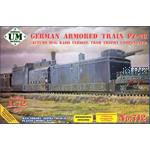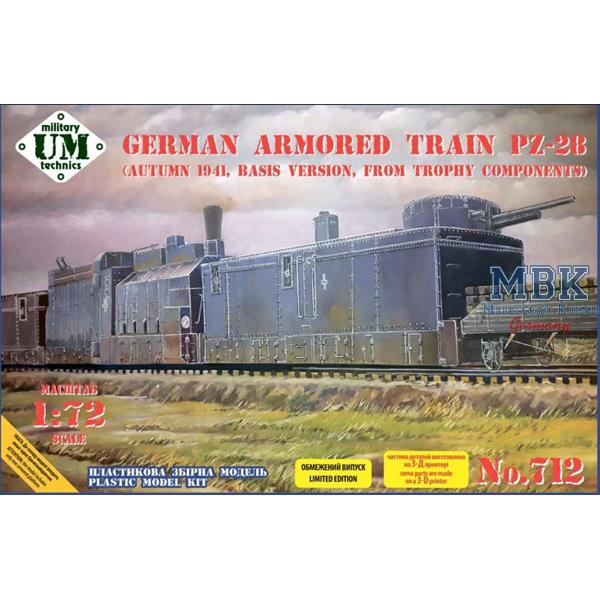
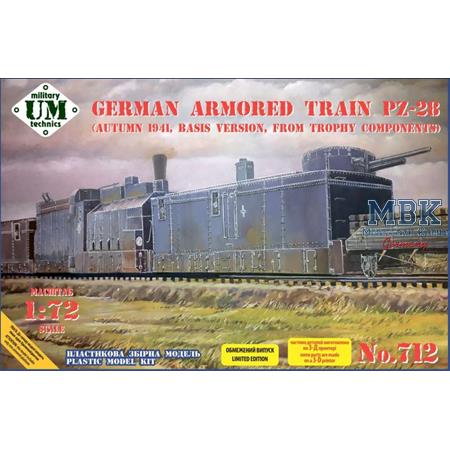
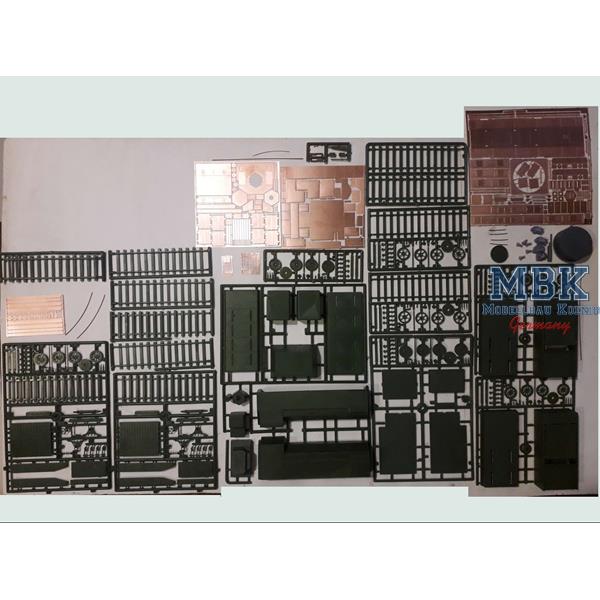
Plastic model kit of a German
PZ-28 armored train in autumn 1941
Limited edition
- Scale 1:72
- Includes 3D printed and photo-etched parts
- Unbuilt, unpainted
- Paint and glue not included
The broad-gauge (1524 mm) armored train PZ-28 was built in Germany in May-June 1941, according to the Barbarossa plan. During the invasion of the USSR, it was a part of the 4th Panzer Army of the CENTER group. Initially, the armored train included: a German steam locomotive of the 57th series, three tank-carrying platforms with French Somua S-35 tanks mounted on them and several open platforms for landing, but in the fall of 1941 the train was replenished with two captured VS-60 armored cars of the Red Army (made in 1931-32). In addition, the German open steam locomotive was replaced by an armored locomotive PR-35 and several control platforms (also captured) were added. The VS-60 armored cars were mounted on the Fox-Arbel chassis (American gondola car), the body was made of non-armored steel. On one edge of the roof of the armored car a cylindrical armored turret (wall thickness-16 mm) was installed, inside which a 107 mm gun (1910 model) and a Maxim machine gun (7.62 mm) in a ball support were mounted as weapons. Each of the armored platforms, in addition, was also armed with 4 Maxim machine guns, installed two on opposite sides of the platform on Verluse-type installations. The armored platform was equipped with steam heating, battery lighting and internal communication systems. The weight was about 70 tons; the crew consisted of more than 20 fighters. In the center of the roof of the car was mounted a hexagonal commander's turret with viewing slots and periscopes. The captured armored locomotive of the Red Army of type PR-35 was made by armoring an Ov type steam locomotive (with a 4-axle tender), the thickness of the armor sheets was 8-10 mm. The armament consisted of a twin 7.62 mm machine gun mount "Maxim," installed in the air defense turret (at the tender). The armored locomotive was equipped with a radio station with a handrail antenna, had a total weight of about 130 tons and had a crew of 17 people. As history has shown, this bepo was further equipped with other components, both German-made and captured (platforms with tanks, etc.). Being constantly in the Center army group, in 1941-42 he acted along the Bryansk-Kursk-Orel line, on the verge of 1942-1943 it was transferred to Rostov, then, following the results of the Red Army offensive, it was retreated with the troops to Ukraine (to the Kharkov-Dnepropetrovsk region), especially distinguished itself in battles near Krivoy Rog, near Cherkassy and Uman. It was repeatedly damaged, lost part of the train, but was restored, but in the summer of 1944 it was again badly damaged in battles and finally lost.
Text UM Military Technics