 Bandai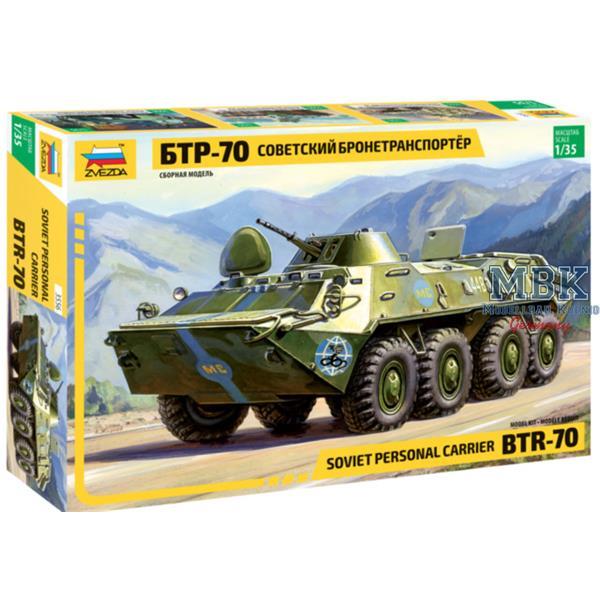


24.50 €
VAT included plus shipping and handling
Unfortunately sold out at the moment
No new delivery date known, if necessary please activate stock alert
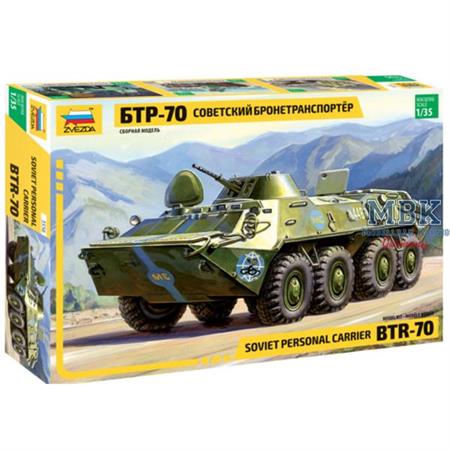
Plastic model kit of a Soviet BTR-70 wheeled armored personnel carrier
Key Data
The BTR-70 was developed as an evolutionary advancement of the BTR-60PB. The main objectives were improved armor protection, increased reliability, and better off-road mobility. Its defining characteristic is its two parallel-driven eight-cylinder engines, which kept the vehicle mobile despite its added weight. The armor protects against infantry weapons and shrapnel, but not against heavy weapons or anti-tank weapons.
Deployment and Distribution
The BTR-70 was produced in large numbers and widely exported. It saw action in Afghanistan (1979–1989) and in conflicts following the collapse of the Soviet Union. Many vehicles remained in service with successor states of the USSR and allied countries after 1991, some modernized or replaced by successor models such as the BTR-80.
Variants
Among the best-known variants are the BTR-70M (diesel engines, improved access hatches), the BTR-70K (command vehicle), and various conversions for reconnaissance, engineering, or medical purposes. Numerous countries developed their own modernizations to adapt the tank to current operational requirements.
Significance
The BTR-70 is considered a prime example of the Soviet philosophy of mobile, lightly armored troop carriers during the Cold War. Its design influenced later models and remained the basis for training and mechanization in many armies well into the 21st century.
- Scale 1:35
- 180 parts
- 21 cm length (assembled)
- Unassembled, unpainted
- Paint and glue not included
Key Data
- Development: Late 1960s to mid-1970s
- Introduction: 1972–1978 in the Soviet Army
- Crew: 2 + up to 8 soldiers
- Armament: 14.5 mm KPVT machine gun, 7.62 mm PKT coaxial machine gun
- Propulsion: Two gasoline engines, 120 hp each
- Top speed: Approx. 80 km/h on roads, 9 km/h in water
The BTR-70 was developed as an evolutionary advancement of the BTR-60PB. The main objectives were improved armor protection, increased reliability, and better off-road mobility. Its defining characteristic is its two parallel-driven eight-cylinder engines, which kept the vehicle mobile despite its added weight. The armor protects against infantry weapons and shrapnel, but not against heavy weapons or anti-tank weapons.
Deployment and Distribution
The BTR-70 was produced in large numbers and widely exported. It saw action in Afghanistan (1979–1989) and in conflicts following the collapse of the Soviet Union. Many vehicles remained in service with successor states of the USSR and allied countries after 1991, some modernized or replaced by successor models such as the BTR-80.
Variants
Among the best-known variants are the BTR-70M (diesel engines, improved access hatches), the BTR-70K (command vehicle), and various conversions for reconnaissance, engineering, or medical purposes. Numerous countries developed their own modernizations to adapt the tank to current operational requirements.
Significance
The BTR-70 is considered a prime example of the Soviet philosophy of mobile, lightly armored troop carriers during the Cold War. Its design influenced later models and remained the basis for training and mechanization in many armies well into the 21st century.
Suitable Accessories

29.50 €*
Customer Reviews 0
Write now your personal experience with this article and help others with their purchase decision.
