 Bandai
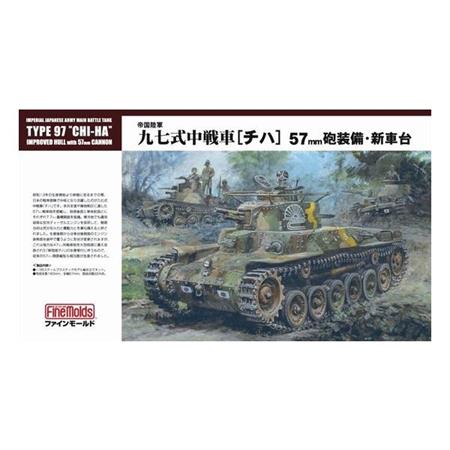

Medium Tank Type 97 CHI-HA Updated Hull
Item Number:
FM-25
FM-25
Manufacturer
Fine Molds
Fine Molds
Scale:
1:35
1:35
47.50 €
VAT included plus shipping and handling
Unfortunately sold out at the moment
No new delivery date known, if necessary please activate stock alert
Plastic model kit of the Imperial Japanese Army's Type 97 Chi-Ha with an improved hull
Like the early versions, this variant was intended for infantry support. The 57mm gun primarily fired high-explosive shells and was particularly effective against field fortifications, machine-gun emplacements, and lightly armored targets. However, its armor-penetration capability was limited against modern Allied main battle tanks; consequently, the Japanese Army focused its further development efforts on the anti-tank 47mm gun.
The improved hull differed from early production vehicles due to various design modifications. These included a simplified manufacturing process involving more extensive welding, redesigned maintenance hatches, and detailed improvements to the air intakes, engine deck, and crew compartment. These changes were primarily intended to streamline production and increase structural strength without significantly altering the tank's basic appearance. Maximum armor thickness remained largely unchanged at up to 25 mm.
The tank, weighing approximately 15 tons, continued to be powered by an air-cooled Mitsubishi V12 diesel engine producing around 170 hp, enabling a top speed of approximately 38 km/h. The proven suspension system - featuring distinctive road wheels and horizontal coil springs - was retained and was noted for its reliability and off-road capability.
The Type 97 Chi-Ha with the improved hull saw service primarily during the later years of the war in China, Southeast Asia, and across the Pacific islands. Due to the Allies' growing material superiority, these vehicles were frequently deployed for infantry support, the defense of prepared positions, or within reserve units. Many remained on the Japanese home islands toward the end of the war to counter an anticipated invasion.
This version is of particular interest to scale modelers, as it depicts the classic Chi-Ha equipped with the original 57 mm gun while simultaneously featuring numerous minor design differences compared to early production models. Depending on the manufacturer, details such as the modified hull front, redesigned maintenance hatches, and engine deck features are accurately reproduced. This makes the variant an excellent choice for building a lesser-known yet historically authentic late-war Chi-Ha.
- 1:35 scale
- Includes clear parts and photo-etched parts
- Hatches can be displayed open
- Detailed running gear
- Four marking options:
- 23rd Tank Regiment, 4th Company, Manchuria 1944
- 9th Tank Regiment, 5th Company, Saipan 1944
- 34th Tank Regiment, 3rd Company, Manchuria 1945
- Independent 14th Tank Company, Jeju Island 1945
- Unassembled, unpainted
- Paint and glue not included
Like the early versions, this variant was intended for infantry support. The 57mm gun primarily fired high-explosive shells and was particularly effective against field fortifications, machine-gun emplacements, and lightly armored targets. However, its armor-penetration capability was limited against modern Allied main battle tanks; consequently, the Japanese Army focused its further development efforts on the anti-tank 47mm gun.
The improved hull differed from early production vehicles due to various design modifications. These included a simplified manufacturing process involving more extensive welding, redesigned maintenance hatches, and detailed improvements to the air intakes, engine deck, and crew compartment. These changes were primarily intended to streamline production and increase structural strength without significantly altering the tank's basic appearance. Maximum armor thickness remained largely unchanged at up to 25 mm.
The tank, weighing approximately 15 tons, continued to be powered by an air-cooled Mitsubishi V12 diesel engine producing around 170 hp, enabling a top speed of approximately 38 km/h. The proven suspension system - featuring distinctive road wheels and horizontal coil springs - was retained and was noted for its reliability and off-road capability.
The Type 97 Chi-Ha with the improved hull saw service primarily during the later years of the war in China, Southeast Asia, and across the Pacific islands. Due to the Allies' growing material superiority, these vehicles were frequently deployed for infantry support, the defense of prepared positions, or within reserve units. Many remained on the Japanese home islands toward the end of the war to counter an anticipated invasion.
This version is of particular interest to scale modelers, as it depicts the classic Chi-Ha equipped with the original 57 mm gun while simultaneously featuring numerous minor design differences compared to early production models. Depending on the manufacturer, details such as the modified hull front, redesigned maintenance hatches, and engine deck features are accurately reproduced. This makes the variant an excellent choice for building a lesser-known yet historically authentic late-war Chi-Ha.
Customer Reviews 0
Write now your personal experience with this article and help others with their purchase decision.
