Bandai
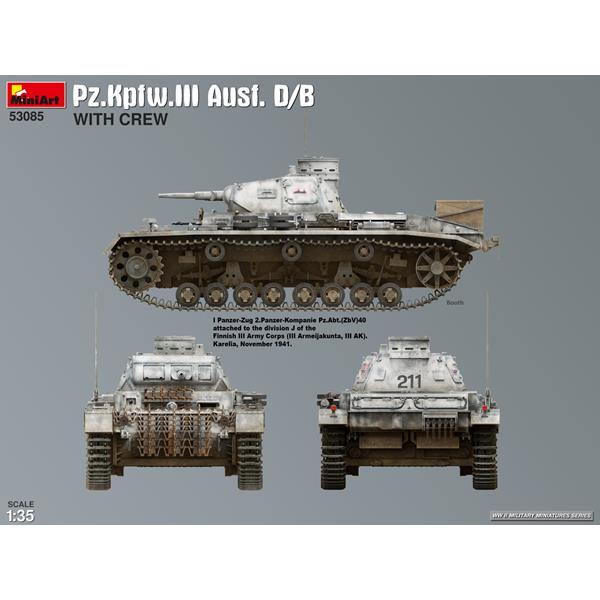
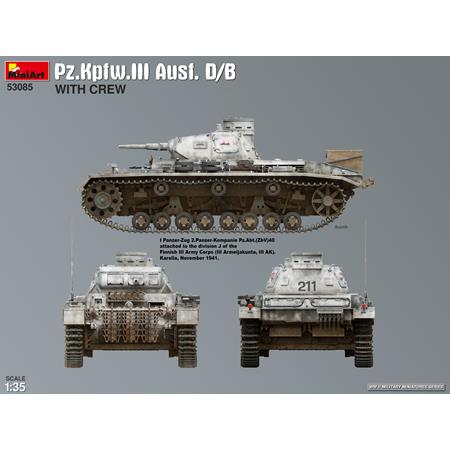
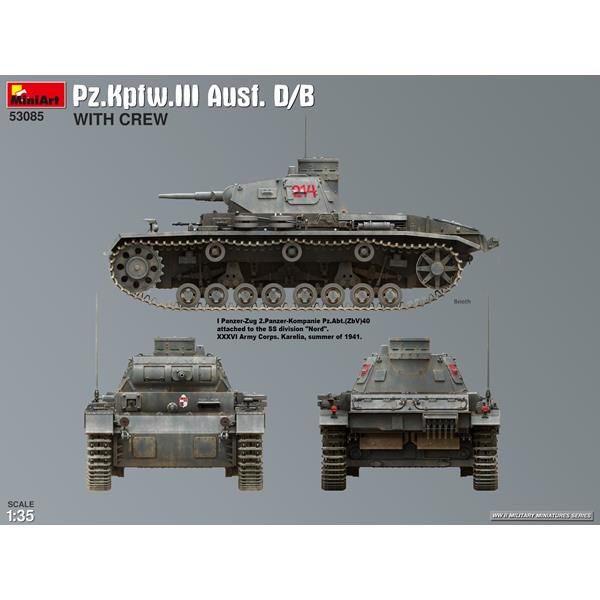
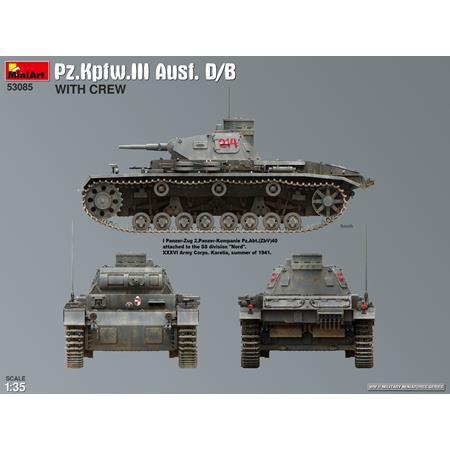


Pz.Kpfw. III Ausf. D/B with Crew
Item Number:
MA53085
MA53085
Manufacturer
MINIART
MINIART
Scale:
1:35
1:35

41.50 €
VAT included plus shipping and handling
Appears soon
We expect to arrive at middle / end of July 2026
Expected to be released middle / end of July 2026
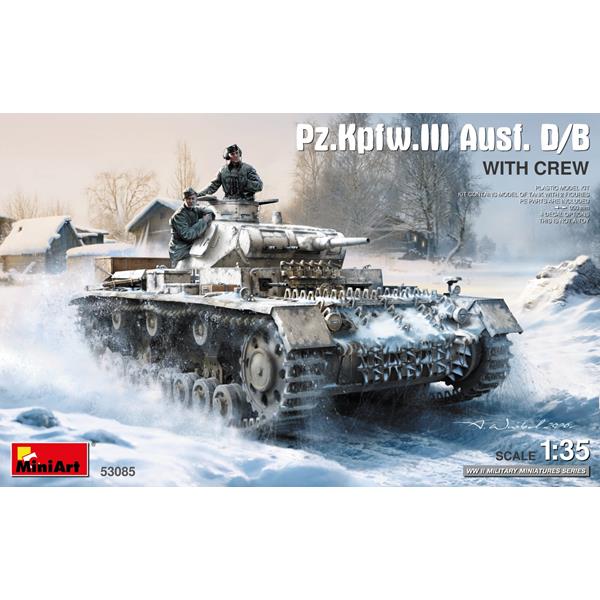
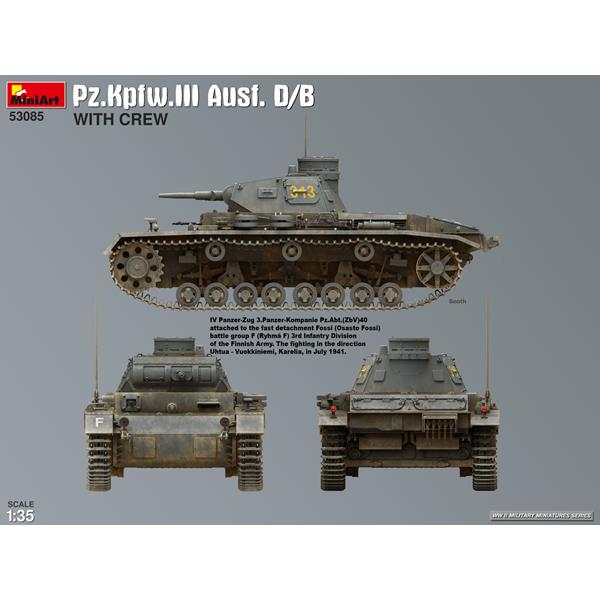
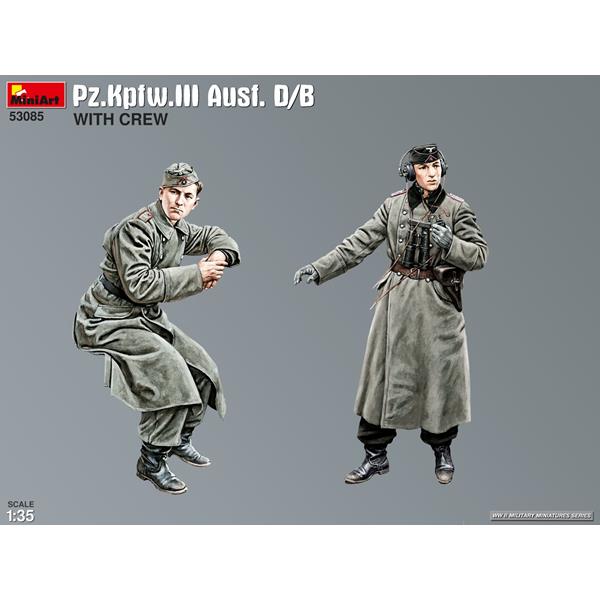
Plastic model kit of a German Panzerkampfwagen III Ausf. D/B with crew members
Technically, the Ausf. D/B was based on the Ausf. D chassis, featuring a revised leaf-spring suspension and eight small road wheels per side. Weighing approximately 16 tons, the tank was powered by a liquid-cooled Maybach HL 108 TR twelve-cylinder gasoline engine producing 250 hp, allowing for a top speed of around 35 km/h. Its armament matched that of early Panzer III variants, consisting of a 3.7 cm KwK 36 L/45 gun and three MG 34 machine guns. A distinctive feature was the older Ausf. B turret with its low, cylindrical commander's cupola, while the chassis and hull reflected the design standards of the Ausf. D. With a maximum thickness of 14.5 mm, the armor remained at the level of early pre-production vehicles, offering protection only against infantry weapons and shrapnel.
The few vehicles built were assigned to Panzer-Abteilung z.b.V. ...40 and were deployed to Finland via Norway, where, starting in 1941, they saw action in the fighting along the Murmansk front. Operations there focused less on combat against enemy tanks and more on supporting infantry across difficult terrain. However, due to their obsolete armament, thin armor, and mounting difficulties in obtaining spare parts, the vehicles rapidly lost their military significance. By 1943, most had been put out of action or repurposed as stationary strongpoints before eventually being retired from service. Despite the limited number produced, the Ausführung D/B variant represents an interesting example of the German armaments industry’s pragmatic use of existing resources and stands today as one of the rarest yet most fascinating versions of the Panzerkampfwagen III.
- 1:35 scale
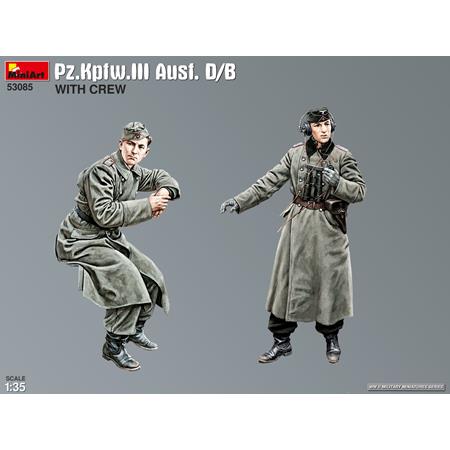
- Includes 2 crew figures
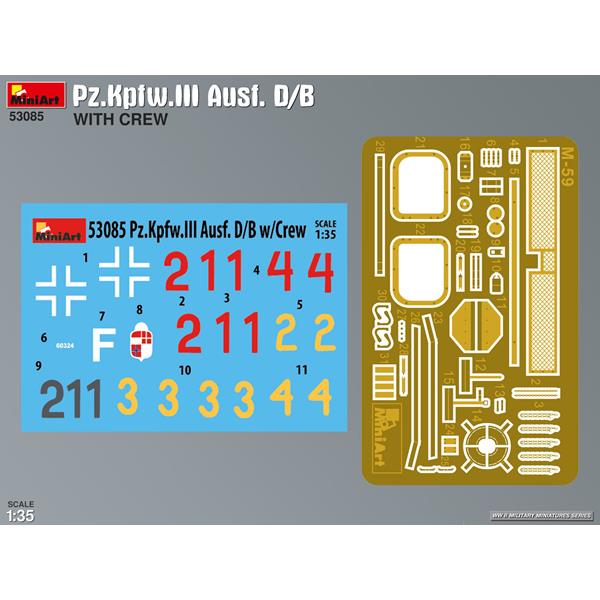
- Clear parts and photo-etched parts included
- Turret interior details included
- Workable individual-link tracks
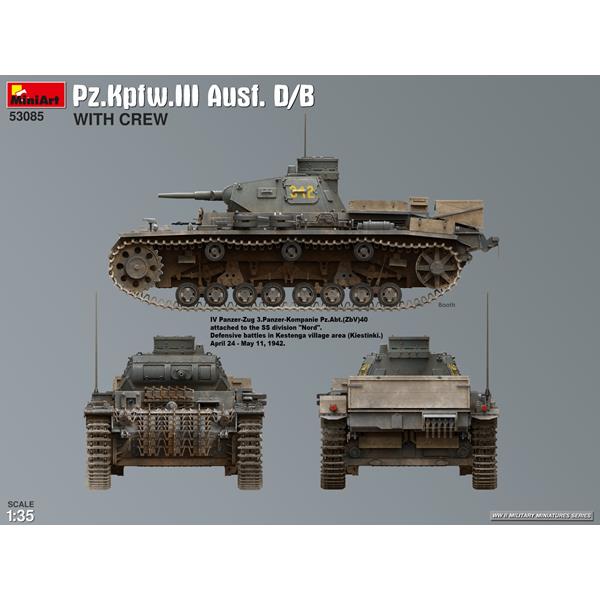
- 4 marking options
- IV. Panzer-Zug, 3. Panzerkompanie, Pz.Abt. (ZbV) 40 attached to the SS Division Nord, defensive battles in Kestenga viallage afrea (Kiestinki.), April 24 - May 11, 1942
- I. Panzer-Zug, 2. Panzerkompanie, Pz.Abt. (ZbV) 40 attached to the Division J of the Finnish III Army Corps (III Armeijakunta, III AK), Karelia, November 1941
- I. Panzer-Zug, 2. Panzerkompanie, Pz.Abt. (ZbV) 40 attached to the SS Division Nord, XXXVI Army Corps, Karealia, Summer of 1942
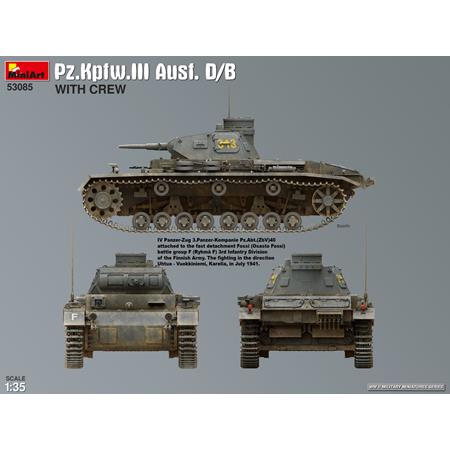
- IV. Panzer-Zug, 3. Panzerkompanie, Pz.Abt. (ZbV) 40 attached to the fast detachment Fossi (Osasto Fossi) battle group F (Rhymä F) 3rd Infantry Division of the Finnish Army. The fighting in the direction Uhtua - Vuokkiniemi, Karelia, in July 1941
- Detailed exterior and running gear
- Unassembled, unpainted
- Paint and glue not included
Technically, the Ausf. D/B was based on the Ausf. D chassis, featuring a revised leaf-spring suspension and eight small road wheels per side. Weighing approximately 16 tons, the tank was powered by a liquid-cooled Maybach HL 108 TR twelve-cylinder gasoline engine producing 250 hp, allowing for a top speed of around 35 km/h. Its armament matched that of early Panzer III variants, consisting of a 3.7 cm KwK 36 L/45 gun and three MG 34 machine guns. A distinctive feature was the older Ausf. B turret with its low, cylindrical commander's cupola, while the chassis and hull reflected the design standards of the Ausf. D. With a maximum thickness of 14.5 mm, the armor remained at the level of early pre-production vehicles, offering protection only against infantry weapons and shrapnel.
The few vehicles built were assigned to Panzer-Abteilung z.b.V. ...40 and were deployed to Finland via Norway, where, starting in 1941, they saw action in the fighting along the Murmansk front. Operations there focused less on combat against enemy tanks and more on supporting infantry across difficult terrain. However, due to their obsolete armament, thin armor, and mounting difficulties in obtaining spare parts, the vehicles rapidly lost their military significance. By 1943, most had been put out of action or repurposed as stationary strongpoints before eventually being retired from service. Despite the limited number produced, the Ausführung D/B variant represents an interesting example of the German armaments industry’s pragmatic use of existing resources and stands today as one of the rarest yet most fascinating versions of the Panzerkampfwagen III.
Customer Reviews 0
Write now your personal experience with this article and help others with their purchase decision.