Bandai
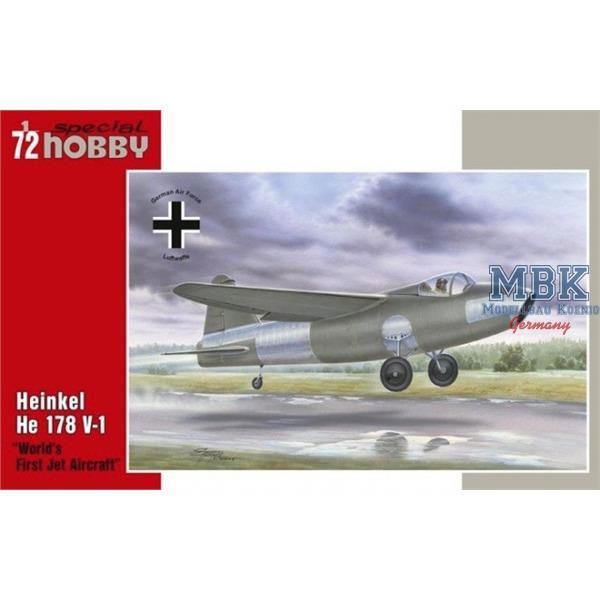

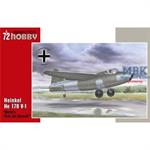
The Heinkel He 178 V1 was the world's first jet aircraft. In 1936, Ernst Heinkel hired Dr. Hans J. Pabst von Ohain and his assistant, Max Hahn, at his factory. They worked on a fundamentally new type of aircraft propulsion: the jet engine.
In September 1937, the first engine prototype, the HeS 1, was tested on a test stand. Although the engine ran on hydrogen and lacked thrust control, it was capable of generating up to 250 kg of thrust. Following the success of the HeS 1 engine, von Ohain began developing the significantly more powerful HeS 3b; this engine ran on gasoline and featured control flaps for regulating power output. Concurrently, work began on the airframe, which was originally designed to accommodate a single jet engine.
The He 178 V1 was a shoulder-wing aircraft with the cockpit located in the forward fuselage, ahead of the wing's leading edge. It featured a metal semi-monocoque fuselage (assembled using flush rivets), wooden wings, and retractable landing gear. However, all test flights were conducted with the landing gear extended and the wheel wells covered. Taxiing trials with the prototype—equipped with the HeS 3b engine—began on August 24, 1939, and on August 27, the aircraft completed its maiden flight at Marienehe Airfield. These marked the flights of the world's first jet aircraft. During the subsequent testing phase, the aircraft was demonstrated to the leadership of the Reich Air Ministry (RLM) on November 1. The He 178 V1 completed a total of 12 flights, all piloted by Captain Erich Warsitz.
Plastic model kit
unbuilt / unpainted
Paint and glue not included
In September 1937, the first engine prototype, the HeS 1, was tested on a test stand. Although the engine ran on hydrogen and lacked thrust control, it was capable of generating up to 250 kg of thrust. Following the success of the HeS 1 engine, von Ohain began developing the significantly more powerful HeS 3b; this engine ran on gasoline and featured control flaps for regulating power output. Concurrently, work began on the airframe, which was originally designed to accommodate a single jet engine.
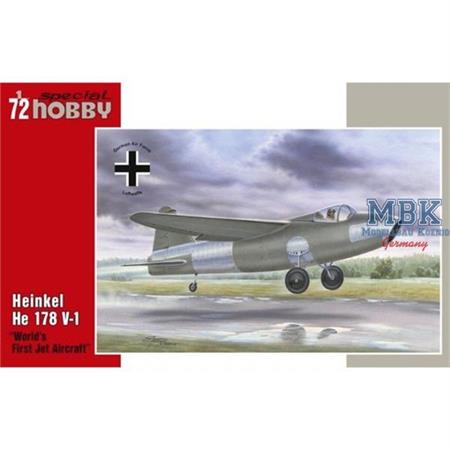
The He 178 V1 was a shoulder-wing aircraft with the cockpit located in the forward fuselage, ahead of the wing's leading edge. It featured a metal semi-monocoque fuselage (assembled using flush rivets), wooden wings, and retractable landing gear. However, all test flights were conducted with the landing gear extended and the wheel wells covered. Taxiing trials with the prototype—equipped with the HeS 3b engine—began on August 24, 1939, and on August 27, the aircraft completed its maiden flight at Marienehe Airfield. These marked the flights of the world's first jet aircraft. During the subsequent testing phase, the aircraft was demonstrated to the leadership of the Reich Air Ministry (RLM) on November 1. The He 178 V1 completed a total of 12 flights, all piloted by Captain Erich Warsitz.
Plastic model kit
- includes photo-etched parts
unbuilt / unpainted
Paint and glue not included
Customer Reviews 1
Write now your personal experience with this article and help others with their purchase decision.
Customers also bought