 Bandai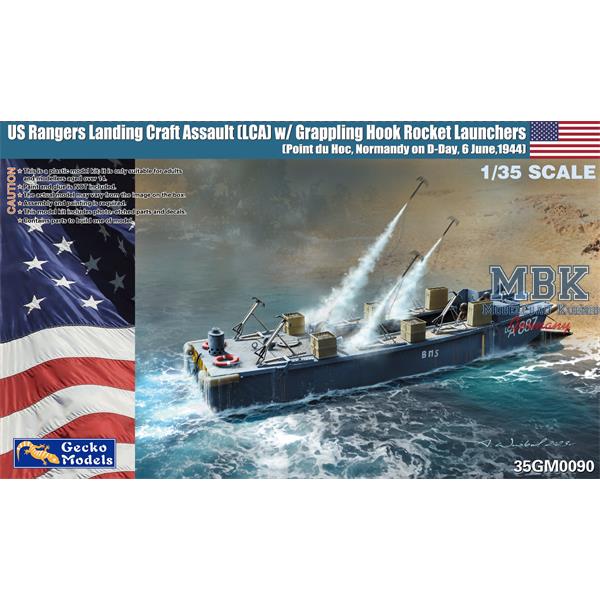
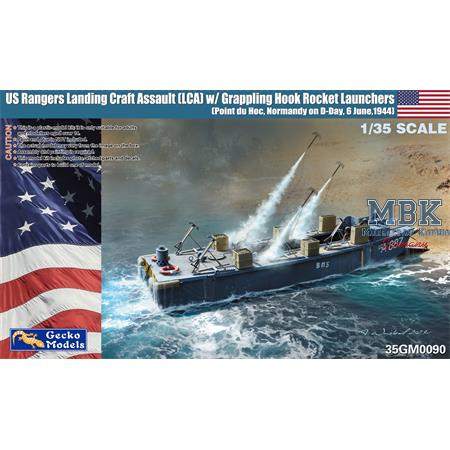

Plastic kit for a landing craft (LCA) of the U.S. Rangers as deployed at Point du Hoc in Normandy on 6 June 1944
The LCA was approximately 12.9 meters long and 3.1 meters wide, with a loaded displacement of about 13 tons. It was powered by two Ford V8 gasoline engines, each producing around 65 hp; driving twin propellers, these engines enabled a top speed of approximately 7 knots (13 km/h). The crew typically consisted of four sailors - a coxswain, engine mechanics, and bow gunners - while the craft could transport up to 36 fully equipped soldiers. Its shallow draft of less than one meter allowed it to approach very close to the beach or - as was the case at Pointe du Hoc - directly up to the cliffs.
A key characteristic of the LCA was its robust construction. The hull was made of wood, featuring light hardened-steel armor around the helm and troop compartment. This provided the boat with better protection against machine-gun fire than many other landing craft. A wide, lowering ramp was located at the bow, allowing soldiers to disembark within seconds. For the Rangers, however, this was of secondary importance, as immediately after landing they used special rockets carrying ropes and assault ladders, as well as extendable fire ladders, to scale the sheer cliffs.
Heavy seas during the approach caused many LCAs to arrive late or drift away from their intended landing sites. Furthermore, German fire, smoke, and sea spray significantly hampered navigation. Nevertheless, the boats succeeded in delivering the majority of the Rangers to the base of the cliffs. The LCAs had to maneuver with extreme precision, as they could only stop a few meters from the rocks. After disembarking the soldiers, they immediately withdrew to avoid further fire and to pick up supplies or reinforcements if necessary.
The deployment of LCAs at Pointe du Hoc clearly demonstrated the landing craft's strengths: a low profile, shallow draft, relatively good armor, and the ability to land infantry with pinpoint accuracy on difficult-to-access stretches of coast, even under heavy enemy fire. In doing so, the British LCA played a decisive role in the U.S. Rangers' successful assault on the German gun battery at Pointe du Hoc - one of the most spectacular special operations of D-Day.
- 1:35 scale
- Grappling hook rocket launchers
- Photo-etched parts and decals included
- Thread for ramp cables, etc.
- Figures not included
- unbuilt, unpainted
- Paint and glue not included
The LCA was approximately 12.9 meters long and 3.1 meters wide, with a loaded displacement of about 13 tons. It was powered by two Ford V8 gasoline engines, each producing around 65 hp; driving twin propellers, these engines enabled a top speed of approximately 7 knots (13 km/h). The crew typically consisted of four sailors - a coxswain, engine mechanics, and bow gunners - while the craft could transport up to 36 fully equipped soldiers. Its shallow draft of less than one meter allowed it to approach very close to the beach or - as was the case at Pointe du Hoc - directly up to the cliffs.
A key characteristic of the LCA was its robust construction. The hull was made of wood, featuring light hardened-steel armor around the helm and troop compartment. This provided the boat with better protection against machine-gun fire than many other landing craft. A wide, lowering ramp was located at the bow, allowing soldiers to disembark within seconds. For the Rangers, however, this was of secondary importance, as immediately after landing they used special rockets carrying ropes and assault ladders, as well as extendable fire ladders, to scale the sheer cliffs.
Heavy seas during the approach caused many LCAs to arrive late or drift away from their intended landing sites. Furthermore, German fire, smoke, and sea spray significantly hampered navigation. Nevertheless, the boats succeeded in delivering the majority of the Rangers to the base of the cliffs. The LCAs had to maneuver with extreme precision, as they could only stop a few meters from the rocks. After disembarking the soldiers, they immediately withdrew to avoid further fire and to pick up supplies or reinforcements if necessary.
The deployment of LCAs at Pointe du Hoc clearly demonstrated the landing craft's strengths: a low profile, shallow draft, relatively good armor, and the ability to land infantry with pinpoint accuracy on difficult-to-access stretches of coast, even under heavy enemy fire. In doing so, the British LCA played a decisive role in the U.S. Rangers' successful assault on the German gun battery at Pointe du Hoc - one of the most spectacular special operations of D-Day.
Customer Reviews 2
Write now your personal experience with this article and help others with their purchase decision.
